
 Location: (Ethiopia)
 Vacancies: 1
 Work modality: Hybrid
Introduction:
Ayuda en Acción (AeA) is a secular, non-partisan, non-governmental organisation established in 1981, with a global commitment to combating poverty, inequality, and social exclusion. Headquartered in Madrid, Spain, the organisation operates in 18 countries across Africa, South and Central America, and Europe. In Ethiopia, Ayuda en Acción supported humanitarian and development interventions through local partners between 2002 and 2017 and established an independent country programme in 2018.
Ayuda en Acción Ethiopia works to address poverty, inequality, and social exclusion by strengthening the capacities of individuals, communities, and institutions to promote inclusive development and ensure a dignified life for all. The organisation implements humanitarian and development interventions in Afar, Oromia, and the Southern Nations, Nationalities and Peoples’ Region (SNNPR), in collaboration with government institutions, local and international partners, research institutions, and private sector actors.
Project Description:
Funded by the European Union under grant reference EuropeAid/179149/DD/ACT/ET-1, the three-year Empowering Futures for Youth and Women beyond Agriculture (EMPOWER) project aims to improve the livelihood security of vulnerable women and youth in Ethiopia by expanding access to inclusive, sustainable, and green employment opportunities. The project is implemented by a consortium led by People in Need (PIN), with Ayuda en Acción (AeA) and Development Expertise Center (DEC) as co-applicants. PIN leads implementation in Oromia, DEC in Tigray, and AeA in selected conflict- and climate-affected areas of Afar National Regional State.
In Afar Region, Ayuda en Acción implements the EMPOWER project in Chifra (Zone 1), Ewa, Gulina (Zone 4), and Abala (Zone 2), as well as through Keluwan Roble Gabata TVET College, Asale TVET College, and Asayita Polytechnic College. The project focuses on strengthening local capacities in agricultural and pastoralist value chains, improving access to technical and vocational education and training (TVET), and promoting sustainable livelihood and employment opportunities for women and youth transitioning from, or continuing within, agricultural and agro-pastoral livelihoods.
The target areas face multiple and interrelated challenges, including recurrent droughts, conflict, displacement, harmful traditional practices, and socioeconomic instability. These challenges have disrupted traditional livelihoods and exacerbated existing gender inequalities. Women and girls experience significant barriers to education, skills development, economic resources, market participation, and decision-making. Harmful practices, including early marriage and female genital mutilation (FGM), further constrain their opportunities for personal development and economic participation. Women's contributions to pastoralist and agricultural value chains, including dairy production, are often undervalued, while their participation in potentially higher-value economic activities remains limited.
These barriers are particularly pronounced among female-headed households, internally displaced persons (IDPs), returnees, survivors of gender-based violence (GBV), and persons with disabilities, who often face multiple and overlapping forms of discrimination and exclusion. Young women and men also encounter limited access to market-oriented technical skills, financial services, decent employment, and entrepreneurship opportunities.
Addressing these challenges requires more than project-level interventions. It also requires institutional commitment, clear policies, practical implementation mechanisms, and accountability systems that embed gender equality and social inclusion into organisational governance, human resource management, service delivery, training, employment, and economic empowerment activities.
To this end, Ayuda en Acción seeks to engage a qualified consultancy firm to undertake institutional Gender Equality and Social Inclusion (GESI) assessments of 13 EMPOWER partner institutions across the Afar Region and provide tailored technical support to strengthen their institutional GESI frameworks. The assignment will cover partner institutions in Semera, Chifra and Chifra Town (Zone 1), Ewa and Gulina (Zone 4), Abala Woreda and Abala Town (Zone 2), as well as Keluwan Roble Gabata TVET College in Gulina, Asale Polytechnic College in Abala, and Adadale Polytechnic College in Asayita.
The consultancy will assess each institution's existing policies, strategies, guidelines, administrative systems, institutional capacities and operational practices relating to gender equality and social inclusion. It will identify institutional gaps, challenges and barriers and engage relevant stakeholders, including institutional leadership, staff, GESI focal persons and other relevant stakeholders, through participatory consultations.
A mandatory differentiated institutional approach shall guide the assignment. The consultant shall not assume that all 13 institutions require new, standalone GESI policies. Instead, each institution shall be assessed individually, considering its legal mandate, institutional authority, existing policy and strategic frameworks, administrative and operational systems, institutional capacity, and identified GESI gaps and priorities. Based on the assessment findings, the consultant shall determine and justify the most appropriate instrument and level of technical support required by each institution. This may include:
For each institution, the consultant shall document the assessment findings, identify existing instruments and institutional gaps, recommend the appropriate approach and provide clear justification. These findings and recommendations shall be presented in an institution specifically GESI diagnostic and recommendations matrix, indicating the proposed instrument, priority areas for action and required institutional support. The matrix shall be submitted to Ayuda en Acción and the respective institutional leadership for review and agreement before the consultant proceeds with developing or revising policies, guidelines or other supporting instruments. The agreed approach shall guide all subsequent consultancy activities and deliverables.
Regardless of the instrument recommended, the consultancy shall ensure that the proposed measures are practical, institutionally appropriate and aligned with each institution's mandate and capacity. They shall include clear implementation arrangements, assigned institutional responsibilities, capacity development requirements, measurable indicators, accountability mechanisms, monitoring and reporting arrangements and, where applicable, resource implications. Attention shall be given to integrating GESI commitments into existing institutional plans, budgets, human resource management systems and service delivery mechanisms to promote institutional ownership, effective implementation and sustainability.
The proposed policies, guidelines and mainstreaming measures are expected to promote gender equality, disability inclusion, meaningful youth participation, safeguarding, protection from sexual exploitation, abuse and harassment, non-discrimination and economic empowerment. They should also establish practical arrangements for implementation, institutional accountability, monitoring, learning and periodic review.
The consultancy shall be guided by relevant national and regional gender equality and social inclusion frameworks, including Ethiopia's National Policy on Women and applicable Afar Regional gender strategies and action plans. It shall also take into consideration relevant international and continental commitments, including the European Union Gender Action Plan III (2021–2025), the Sustainable Development Goals, particularly SDGs 5, 8 and 16, the African Union's Agenda 2063 and the Convention on the Elimination of All Forms of Discrimination against Women (CEDAW), as applicable.
Through this consultancy, Ayuda en Acción aims to strengthen the capacity and ownership of its EMPOWER partner institutions to adopt and implement practical, context-responsive and sustainable approaches to gender equality and social inclusion. Ultimately, the assignment should contribute to more equitable access to skills development, decent work, entrepreneurship, financial services, markets and livelihood opportunities for women, youth and other marginalised groups in the Afar Region.
Overall Objective:
The overall objective of the consultancy is to assess the institutional capacity, existing policies, systems and operational practices of the 13 EMPOWER partner institutions and support the development, strengthening and institutionalization of practical Gender Equality and Social Inclusion (GESI) frameworks tailored to their respective mandates, legal authorities and operational contexts. Based on the assessment findings, the consultancy will determine the most appropriate institutional support for each institution, whether through developing new GESI policies, reviewing and strengthening existing instruments, developing operational guidelines and procedures, or mainstreaming GESI commitments into existing institutional systems. The assignment will also strengthen institutional ownership and capacity by establishing practical implementation arrangements, clearly defined responsibilities, accountability mechanisms, measurable indicators, and monitoring, reporting, learning and periodic review processes. Ultimately, it aims to ensure that GESI commitments are translated into tangible and sustainable improvements in institutional practices, equitable service delivery, and access to skills development, employment, entrepreneurship and livelihood opportunities for women, youth and other marginalized groups in the Afar Region.
Specific Objectives:
The consultancy will pursue the following specific objectives
Scope of Work:
The consultant will work closely with the EMPOWER project team, the 13 partner institutions, and other relevant stakeholders to assess institutional systems, identify GESI gaps, and develop practical policies and implementation plans.
The main tasks include:
Map the 13 institutions by mandate and category and prepare an institution specific GESI gap and priority matrix, identifying approval authority and existing instruments to be strengthened.
Translate EMPOWER GESI and Barrier analysis findings into practical measures relevant to each institution.
Provide hand on technical support to institutional leadership and focal persons to integrate GESI measures in to annual plans, budget, human resources, service delivery and monitoring system.
Methodology:
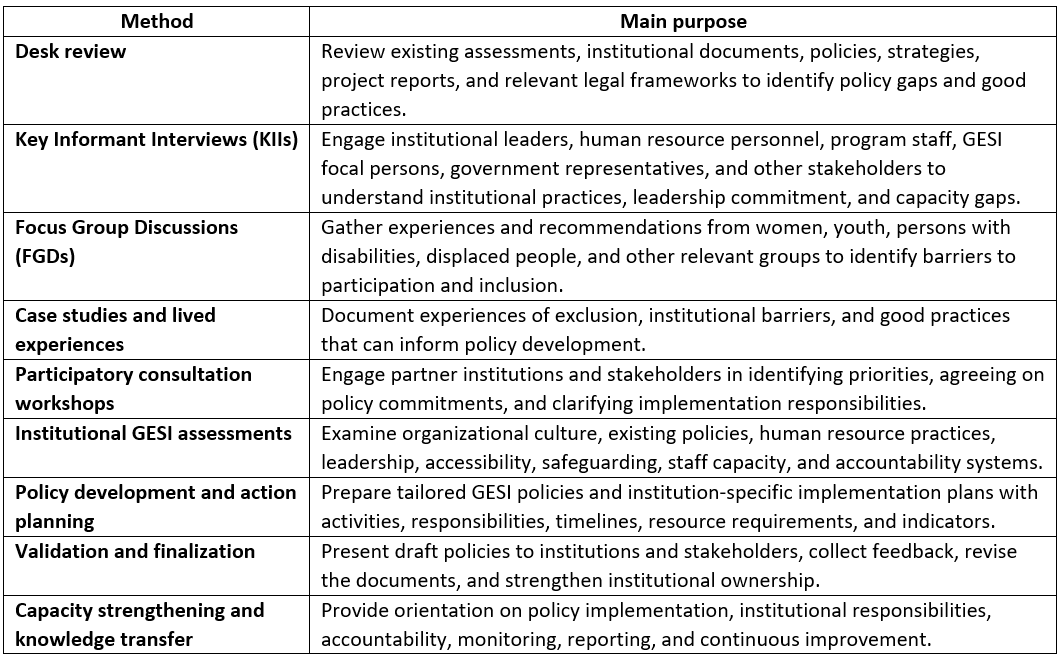
The consultancy will employ a mixed-method, participatory, and intersectional approach to ensure that the policies are evidence-based, practical, inclusive, and responsive to the needs of individual institutions.
The following methods will be applied:
The consultant shall define an institution- by- institution consultation plan and use accessible, confidential and conflict sensitive data collection, with informed consent and appropriate safeguarding measures. Existing evidence should be used to avoid unnecessary collection of sensitive personal experience.
All stages of the consultancy will apply the following principles:
Expected Deliverables:
The consultancy will produce five major deliverables.
Deliverable 1: Inception Report
The inception report will demonstrate the consultant's understanding of the assignment and present the proposed methodology and workplan.
It will include:
Deliverable 2: Institutional Consultation and Assessment Report
The report shall include a concise diagnostic profile and prioritized gap action matrix for each of the 13 institutions, identifying the evidence, institutional mandate, proposed response and responsible decision maker.
This report will document consultations and institutional assessments conducted with all 13 partner institutions.
It will include:
Deliverable 3: Draft Institutional GESI Policy Package
The consultant will prepare 13 draft GESI policies, each tailored to the respective institution's mandate, organizational structure, and operational context.
Each policy will include:
Expected output: Fifteen draft institutional GESI policies accompanied by proposed implementation action plans.
Deliverable 4: Validation Workshop and Stakeholder Feedback Report
The consultant shall organize and facilitate a joint validation workshop involving representatives of the 13 partner institutions, the EMPOWER consortium, implementing partners, and other relevant stakeholders.
The workshop shall:
The joint workshop shall serve as a platform for collective review and feedback but shall not, on its own, constitute sufficient validation. The consultant shall undertake additional institution-specific consultations to validate each policy and its implementation action plan with the leadership and designated policy owner of the relevant institution.
The consultant shall submit:
Finalization of each policy and its implementation action plan shall be subject to validation and confirmation by the respective institution’s leadership and designated policy owner. Any outstanding decisions should be clearly documented for follow-up.
Deliverable 5: Final Institutional GESI Package and Consultancy Completion Report
The consultant shall submit the final institutional GESI package, incorporating feedback from stakeholder consultations, institutional reviews and validation processes. The final package shall reflect the agreed, institution-specific approach and the appropriate GESI instruments identified for each of the 13 EMPOWER partner institutions.
The final package shall include:
All final instruments and supporting documents shall be submitted in editable electronic formats and organized separately for each institution, alongside consolidated reports and tools. The consultant shall ensure that the final package is reviewed and accepted by Ayuda en Acción and that the relevant institutional leadership has been engaged in the validation and adoption process.
Final approval: All deliverables will be reviewed and approved by the designated Ayuda en Acción Ethiopia Interim Country Director, Operational Director, and EMPOWER project Coordinator and consortium representatives.
Key Components of Each Institutional GESI Policy:
The content and operational commitments shall be adopted to the institution functions, particularly equitable access to skill training, decent work, financial products, productive assets and markets as applicable. Measures shall also address disability accessibility, gender responsive planning and budgeting and safe feedback channels.
Each institutional GESI policy should address the following key components:
Expected Results:
The consultancy is expected to achieve the following results:
Policy and Strategic Alignment:
The consultancy will align with relevant national, regional, continental, and international frameworks, including:
Responsibility of Ayuda en Acción Ethiopia:
Guiding principle:
The Consultancy firm should adhere to the following underlying principles in addition to the approaches required for assessment and curriculum development.
Schedule:
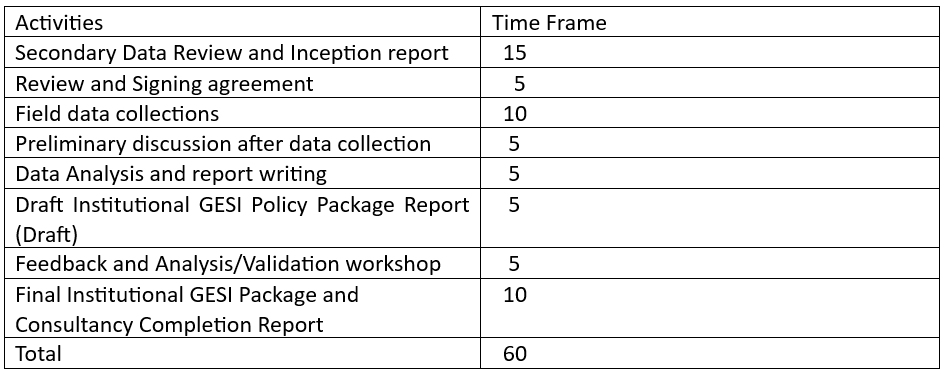
The study is expected to be completed within 60 calendar days. The preliminary calendar to develop the gender-inclusive market system assessment upon agreement, is outlined in the table below.
Minimum requirements to conduct the study:
Presentation of technical and financial proposal:
The consultant is required to submit a signed Letter of Interest, including scanned stamped copies of technical and financial proposal.
The technical proposal shall include:
The financial offer shall include:
Line of reporting:
The Consultant Firm must report to the contact persons in Ayuda en Acción Ethiopia Interim Country Director and Operational Director as per the schedule.
Payment schedule:
The payments are proposed as follows:
Process and criteria for Selecting the Best Offer:
The selection of the best proposal will be done by using the Combined Scoring method – where the qualifications, relevant experiences and methodology will be weighted a maximum of 70% and combined with the price offer which will be weighted a maximum of 30%. The technical part of the application will be assessed based on previous experience of knowing Afar context and doing similar activities with the previous clients.
The selection process includes shortlisting of candidate’s base based on submitted technical and financial proposal. Additionally, the top three shortlisted consultants will present methodologies and major deliverables to Ayuda en Acción Management and team of experts, which will determine the final selection.
The following technical elements will be considered:
How to apply:
The Consultant is expected to submit Letter of Interest, along with the scanned stamped copies of technical and financial proposal directly through (only) the talent clue within 10 (Ten) consecutive days from the advertisement.
Key Contacts:
You may send your questions prior to submission to:
In all selection processes, we will consider the criteria of NO discrimination based on sex, race, skin colour, religion, political ideas, social origin, sexual orientation, age, etc., providing a transparent and equal opportunity process for all candidates, as stated in our Code of Conduct. "Treating all people with respect and rejecting any kind of harassment, discrimination, intimidation, exploitation or any other action against Human Rights".
At Ayuda en Acción we have zero tolerance for behavior related to sexual exploitation, sexual abuse, and/or sexual harassment, which is why, in accordance with our Child Protection Policy, we are committed to carrying out a series of checks prior to hiring by requesting information from previous employers through the Misconduct Disclosure Scheme (The Misconduct Disclosure Scheme misconduct-disclosure-scheme.org) no the event that said employers are members of this platform.
In addition, Ayuda en Acción also undertakes to provide the other members of the MDS with the information corresponding to this type of event on employees who have worked for the Organization. Therefore, by submitting this application, the applicant accepts and authorizes the performance of these pre-employment checks in order to continue in the selection process and the conservation of his/her data for subsequent consultation by MDS members. The information extracted from this application for references will be used in a Private, Confidential and Internal manner and will only be used for the selection processes of Ayuda en Acción in which the candidate has registered. Therefore, by submitting this application, the applicant accepts and authorizes these checks to be carried out in order to continue in the selection process. In addition, it will be compulsory to present the "Negative Certification of the Central Registry of Sex Offenders" prior to the incorporation.
